
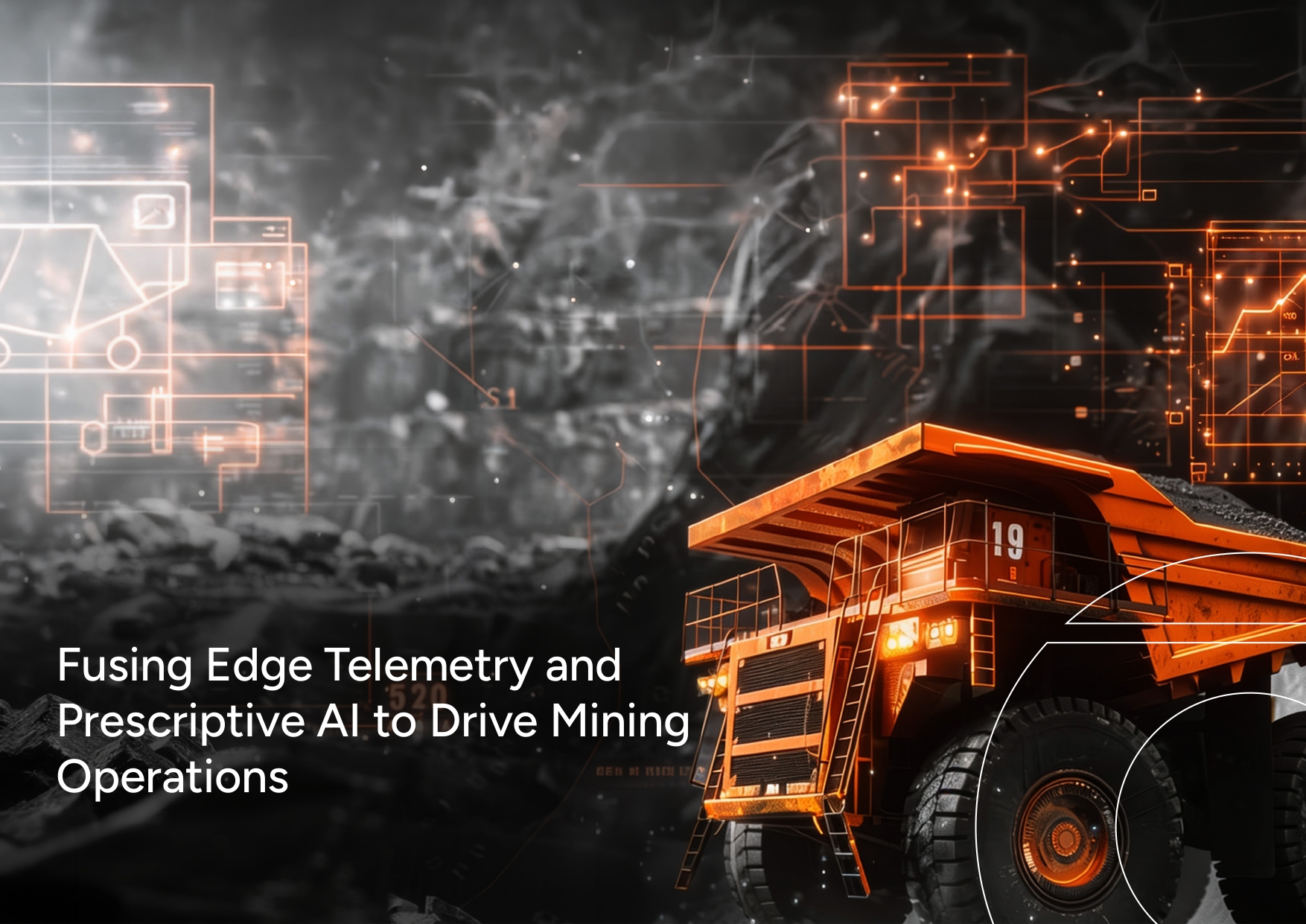
Fusing Edge Telemetry and Prescriptive AI to Drive Mining Operations Despite high AI adoption, over 80% of enterprises report zero bottom-line contribution—a structural disconnect known as the Gen AI Paradox, driven by passive copilots that fail to execute work. In capital-intensive mining, critical intelligence remains trapped across decoupled fleet dynamics, proprietary machine telemetry, and unstructured shift handovers. This paper presents a closed-loop, 5-stage architectural framework that fuses edge telemetry with domain-adapted AI to automate frontline triage, eliminate haulage bottlenecks, and drive prescriptive operational action.

Proprietary OEM protocols and remote extraction sites isolate critical machinery data, causing haulage productivity to slide 12% to 25% below capacity. By deploying containerised edge runtimes directly on mobile fleets and plant assets, operations capture high-frequency CAN-bus, tri-axial vibration, and GNSS streams to eliminate physical blind spots and deliver real-time state synchronisation.

Critical failure symptoms frequently remain trapped in free-text shift handovers and inspection check-sheets that standard analytics ignore. Coupling Technical Language Processing (TLP) with Textual Case-Based Reasoning (TCBR) enables systems to parse industrial maintenance syntax, raising breakdown diagnostic matching precision from a 58% baseline to 95%.
Passive control-room dashboards induce alarm fatigue and stretch incident resolution cycles. Deploying autonomous agentic orchestrators translates predictive Remaining Useful Life (RUL) inference directly into deterministic physical actions such as autonomously generating CMMS work orders, reserving replacement inventory, and dynamically rerouting haul trucks within auditable Policy-as-Code safety guardrails.

.png)






%20(1).png)